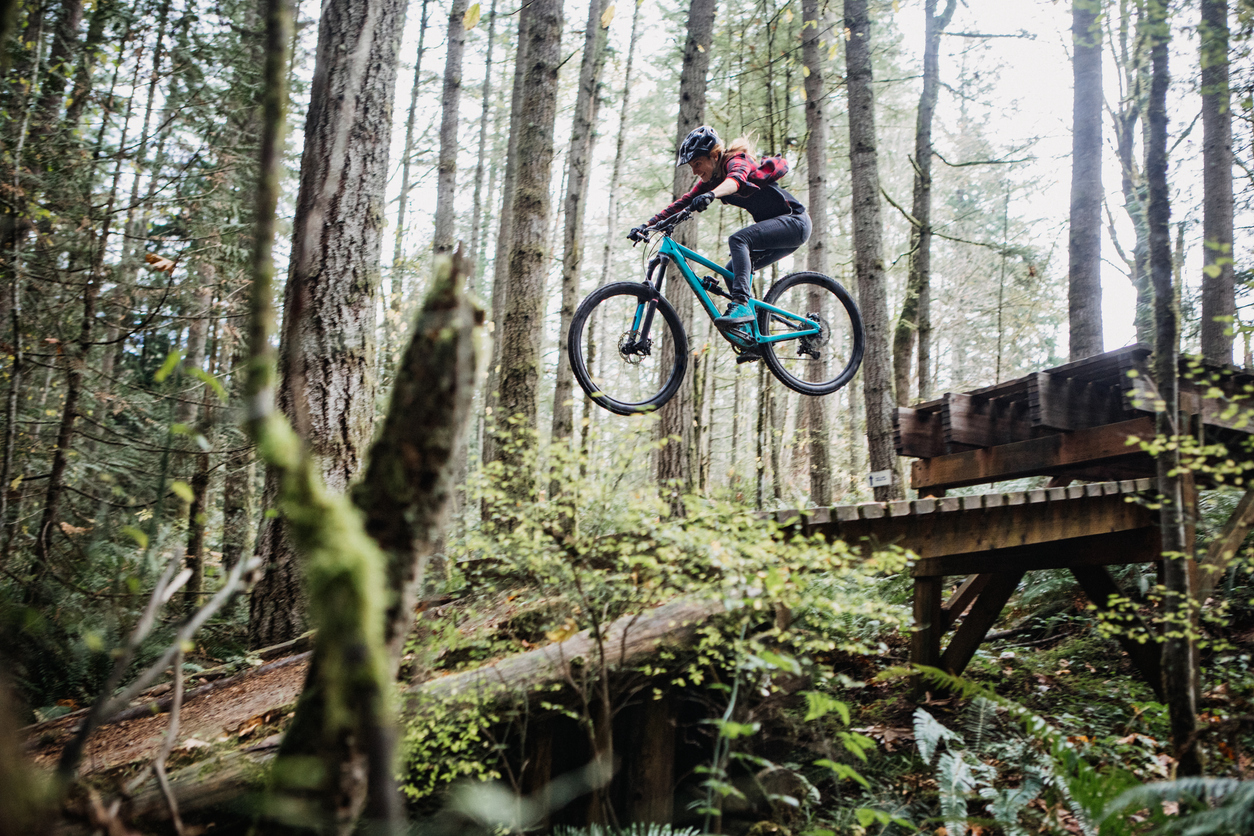
There’s a thing that happens to mountain bikers on narrow bridges.
The bridge is wide enough. There’s plenty of room. But the moment a rider’s eyes drop and lock onto the edge — the thing they’re trying not to hit — the handlebars start to wobble. And more often than not, they end up exactly where they were staring.
The fix is simple: Look where you want to go. Eyes up, focused ahead, and the body follows.
We go where we are looking. 👀
What the Brain Science Says 🧠
Here’s the part that gets me genuinely excited — because this isn’t just a riding tip. This is how your brain actually works. And once you understand it, you’ll see it everywhere.
Your Brain Runs Two Visual Pathways at Once
Your visual system has two streams running in parallel. One identifies what you’re seeing. The other handles where things are and how to move through them — and it operates at near-unconscious speed, feeding directly into your body’s movement system.
When a rider’s eyes sweep over an obstacle a few seconds ahead, that second pathway has already encoded its location and started loading a response into the body — before the conscious mind even registers it. Your hands know something is coming before you do.
This is why experienced riders describe the trail “flowing” under them. The terrain is being handled before it arrives. The body is already writing the response.
The Cerebellum Is Your Body’s Script Writer ✍️
The structure doing most of this work is the cerebellum — a region at the base of the brain that acts as the body’s real-time movement coordinator. It continuously builds a predictive map: where your body is, where it’s going, what adjustments are coming next. It’s writing a motor script for the immediate future and executing it faster than conscious thought ever could.
The further ahead your gaze reaches, the richer that script becomes. Corrections happen before the obstacle arrives, not in a panicked reaction to it.
Tighten that gaze — stare only at what’s right in front of you — and the script falls apart. The brain is always running behind. Every obstacle becomes a surprise. You shift from flowing to scrambling.
The Prefrontal Cortex Needs to Step Back 🤫
Here’s where it gets really interesting. When a rider softens their gaze and looks further ahead, something shifts beyond just the mechanics. The brain’s deliberate, self-monitoring center — the prefrontal cortex — quietly steps back. The inner voice that narrates everything (watch that root, don’t mess this up, brake here) gets quieter.
And in that quiet? The body performs better.
This is not a metaphor. Research shows that conscious, effortful attention directed at a well-learned skill is one of the most reliable ways to degrade performance — what researchers call “paralysis by analysis.” Expert athletes across every discipline show lower prefrontal activation during peak performance, not higher.
The expert brain trusts its own systems. Eyes ahead is the signal to stop micromanaging and let the body do what it knows.
The Amygdala and the Fear Loop 😬
And then there’s fear. When a rider stares at the thing they don’t want to hit — the rock, the drop, the narrow edge — the brain’s alarm center, the amygdala, flags it as a threat. Stress hormones flood in. Muscles tighten. Breathing shallows. The body prepares to freeze or flee at exactly the moment it needs to flow.
Eyes up breaks the loop. When you look through an obstacle — fixing your gaze on where you want to be rather than what you want to avoid — the amygdala’s alarm quiets. The threat shrinks in the brain’s internal model because you’re no longer oriented toward it.
Here’s the part I love most: Confidence isn’t a personality trait. It’s largely a gaze direction. ✨
What This Means for Us 💛
Whether you’re parenting a kid with ADHD, dyslexia, autism, or a mix of things that don’t fit any neat label — or you’re an adult who’s spent years being told you’re doing it wrong — it’s easy to get stuck staring at the edge.
The bad grade. The call from school. The meltdown at the birthday party. The thing your boss said. The task you still haven’t done.
These things are real. They matter.
But when that’s all we’re looking at, our hands start to wobble.
Look Up 🌅
The rider doesn’t pretend the bridge isn’t narrow. The fear is valid. But the gaze keeps moving forward — through the obstacle, toward where they want to land.
This isn’t about pretending things are fine. It’s about where you aim your attention.
What do you want for your kid five years from now? What do you want for yourself one year from now? What would it feel like to be doing just a little better than today?
Start there. Look there.
The Power of Looking Ahead 🔭
Here’s something I believe deeply: Dreaming is not wishful thinking. It’s functional.
When you have a vision — even a loose one, even just a feeling more than a plan — your brain quietly starts working toward it. You notice different things. You make different choices. You reach for different opportunities. Your actions follow your gaze.
Setting a goal, letting yourself imagine something better, daring to say “I want this” out loud — these aren’t indulgences. They are directions. And direction changes everything.
You don’t have to have it all figured out. You just have to be looking somewhere ahead. 🌱
So if the weight of the day-to-day has had your eyes locked on the ground — look up.
Your brain will start writing the script.
