
If you’ve ever watched your child spend three hours on a video game and then fall apart over a five-minute chore, you’ve probably thought, “If you can focus on that, you can focus on this.” 🎮
I hear it from almost every parent with whom I work. The answer opens up a fresh perspective, so I love explaining it.
It’s not a knowledge problem. It’s a doing problem. 🧠
One of the most important ideas in the ADHD field comes from Dr. Russell Barkley, who has spent decades studying this. His point is that kids with ADHD usually know what to do. The struggle is doing it at the moment it needs to be done. He calls this a problem of performance, not knowledge. That’s why lectures, reminders, and “try harder” don’t fix it.
Where dopamine comes in 🔋
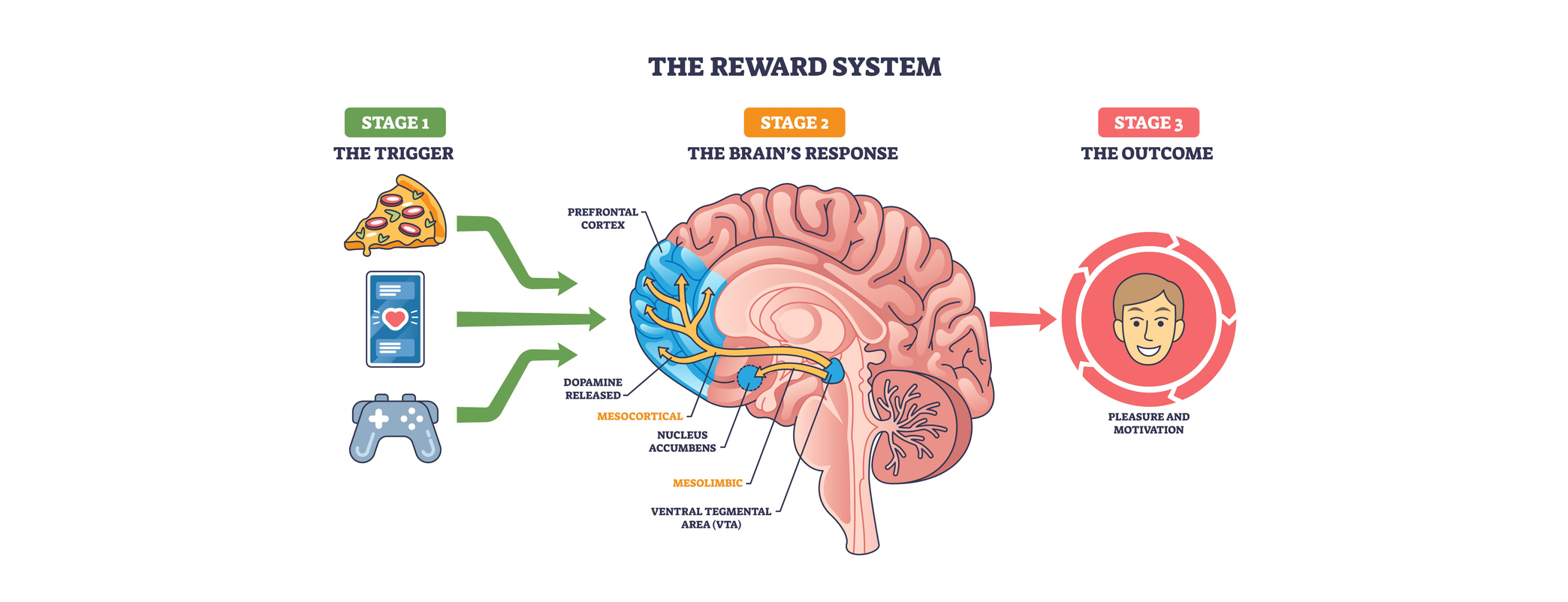
Dopamine isn’t just the “feel-good” chemical. It’s a big part of the brain’s motivation and reward circuit, the system that tells us this matters, start, and keep going.
In ADHD, this system works differently. Brain imaging research (including work by Dr. Nora Volkow) has found differences in the brain’s dopamine reward pathway in people with ADHD, and those differences are linked to motivation. It’s not that the brain has “no” dopamine. It’s that the signal connecting effort to reward doesn’t fire as strongly for tasks that aren’t interesting in the moment.
That’s the key. Tasks that are interesting, new, or exciting get the signal. Tasks that are boring but important (homework, chores, getting dressed) often don’t. Here’s the part I wish every parent knew: the ADHD brain isn’t weak on motivation. It’s particular about where motivation comes from. 💛
What the ADHD brain needs: rewards that are concrete, immediate, and frequent ⏱️
Barkley emphasizes that people with ADHD respond best when the rewards and consequences are:
- Concrete. Something they can see, touch, or check off; not an abstract idea.
- Immediate. Right away, because the future feels very far away. Things that aren’t happening now don’t carry much weight in behavior change.
- Frequent. Small and often, not one big reward at the end. A single payoff at the finish line is too far off to keep the engine running.
That’s exactly why video games work so well. They deliver instant feedback, constant progress, and tiny rewards every few seconds. Meanwhile, a worksheet says “no payoff until you’re done.” For an ADHD brain, that’s a long, quiet stretch with nothing to hold on to. 📚
What this looks like at home 🌱
- Break it into small chunks with a reward after each one. Two math problems, then a quick stretch, instead of “finish all your homework, then screen time.”
- Make progress visible. Checklists, sticker charts, a jar of marbles, or a simple timer let the brain see the payoff.
- Use the “point of performance.” Barkley’s advice is to put the supports where and when the task happens, not hours before or after. Reminders, timers, and visual cues should live right where the work is.
- Body-double, work alongside them. Sitting nearby when they start can make a surprising difference. 💬
This gives the brain the kind of fuel it actually runs on. Some kids without ADHD often get a built-in reward from simply finishing. However, to get some traction at the beginning, they often need us to supply the reward from the outside.
For kids on medication, this is part of why it can help. Stimulant and non-stimulant ADHD medications work on the dopamine and norepinephrine systems, which can make it easier for the brain to register that boring-but-important tasks matter. If you’re wondering how it’s working for your child, your prescriber is the best person to ask.
The takeaway: your child isn’t choosing to focus on some things and ignoring others. Their reward system responds differently to different kinds of tasks. Once you understand that, you can stop fighting it and start building around it. 💛
Warmly,
Liz Adams, PhD, LP, ABPP
Board Certified Neuropsychologist
Founder & CEO Minnesota Neuropsychology
📚 Want to read more?
- Volkow, N. D., et al. (2009). Evaluating dopamine reward pathway in ADHD: Clinical implications. JAMA, 302(10), 1084-1091.
- Volkow, N. D., et al. (2011). Motivation deficit in ADHD is associated with dysfunction of the dopamine reward pathway. Molecular Psychiatry, 16(11), 1147-1154.
- Barkley, R. A. (1997). Behavioral inhibition, sustained attention, and executive functions: Constructing a unifying theory of ADHD. Psychological Bulletin, 121(1), 65-94.
- Barkley, R. A. (2020). Taking Charge of ADHD (4th ed.). Guilford Press.
